
After the study from China about screen addiction, it’s India’s turn.
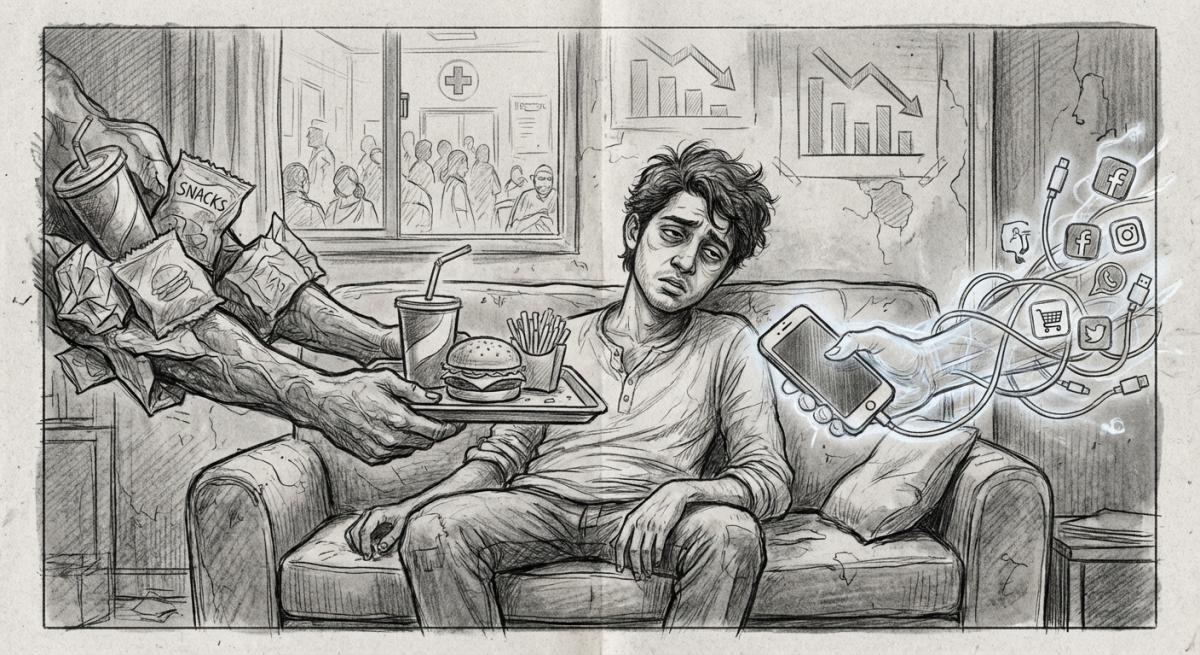
India’s Economic Survey 2025–26 has flagged a troubling trio of public health crises: rising obesity, mental health decline, and digital addiction, all fueled by rapid urbanization, processed food consumption, and near-universal smartphone access. The report warns these trends are eroding productivity, straining healthcare systems, and creating long-term economic burdens.
The Hidden Costs of a Hyper-Digital, Hyper-Processed Life
1. Obesity Isn’t Just About Food, It’s About an Ecosystem Designed to Hook Us
The Survey highlights a startling rise in obesity across all age groups, with over 3.3 crore Indian children already affected—a number projected to more than double by 2035. The culprit? Ultra-processed foods (UPFs), whose sales in India exploded by 150% between 2009 and 2023. These aren’t just snacks; they’re engineered for addiction, packed with sugar, salt, and additives that override natural satiety signals. The food industry knows this. Studies show that UPFs trigger dopamine responses similar to nicotine or alcohol, making them harder to resist than whole foods.
But here’s the kicker: This isn’t an accident. Food corporations spend billions on R&D to optimize for “cravability,” not nutrition. Meanwhile, government campaigns like Eat Right India or Fit India are fighting an uphill battle against an industry that profits from dependency. The Survey admits what public health experts have long warned: Individual willpower can’t outmatch systemic manipulation. Without stricter regulations on marketing, labeling, and formulation, UPFs will keep driving obesity, and the diabetes, heart disease, and healthcare costs that follow.
2. Smartphones Aren’t Just Tools, they’re Attention Extraction Machines
The Survey’s warnings about digital addiction should surprise no one who’s watched a teenager (or themselves) scroll Instagram for hours. With 96.96 crore internet users and 85.5% of households owning smartphones, India’s digital immersion is near-total. The problem isn’t the tech itself, it’s the business model behind it. Social media platforms, games, and even “productivity apps” are built on engagement metrics that reward compulsive use. Every like, swipe, or notification triggers a dopamine hit, creating a feedback loop that rewires behavior.
The consequences are brutal:
- Mental health collapse: The Survey links compulsive scrolling to anxiety, depression, and sleep disorders. Gaming addiction is tied to aggression, financial ruin, and even suicidal ideation.
- Productivity drain: “Lost study hours” aren’t just a personal issue, they translate to a less skilled workforce and slower economic growth.
- Social fragmentation: Algorithms that amplify outrage and comparison erode trust and community cohesion.
India’s response so far—helplines like Tele-MANAS and the Online Gaming (Regulation) Act—is a start, but it’s reactive. The real fix requires holding platforms accountable for design choices that exploit psychology. Why should Meta or ByteDance face zero liability for features that they know harm mental health?
3. The Bigger Picture: Who Profits When Society Pays?
Both crises—obesity and digital addiction—share a root cause: Corporations profit from behaviors that harm individuals and strain public systems. Food giants sell addiction; tech giants sell attention. Meanwhile, the costs, healthcare bills, lost productivity, mental health epidemics, are socialized, borne by taxpayers and families.
The Survey’s call for “preventive care and behavioral change strategies” is necessary but insufficient. Real change requires:
- Breaking the addiction economy: Taxes on UPFs, bans on predatory advertising (especially to kids), and mandatory warnings on hyper-processed foods.
- Redesigning tech for human well-being: Algorithmic transparency, default screen-time limits, and penalties for platforms that optimize for compulsive use.
- Public investment in alternatives: Subsidies for whole foods, digital detox programs in schools, and urban planning that prioritizes physical activity over screen time.
Without these, we’re stuck in a cycle where private gains create public losses, and the most vulnerable (kids, low-income families) pay the highest price.
This Isn’t Just a “Tech Problem”—It’s a Society Problem
The Economic Survey isn’t just sounding an alarm for policymakers. It’s a wake-up call for everyone who’s ever mindlessly scrolled, binge-eaten processed snacks, or felt anxious after doomscrolling. These aren’t personal failings, they’re predictable outcomes of systems designed to exploit our biology.
But here’s the good news: Awareness is the first step toward resistance.
- For individuals: Set app limits, delete addictive platforms, and treat UPFs like what they are, occasional indulgences, not staples.
- For parents: Delay smartphone access for kids, model healthy habits, and demand better from schools (e.g., phone-free classrooms).
- For citizens: Push for policies that shift costs back to the corporations creating the harm. Support food labeling laws, digital well-being regulations, and taxes on junk food and data exploitation.
Technology and processed food can enhance life, but only if we control them, not the other way around. Right now, the scales are tipped dangerously in favor of those who profit from our compulsions. The question is: How long will we let them?
Read the original article here if you want to learn more:
Economic Survey raises alarm over obesity, compulsive scrolling and digital addiction
Subscribe to our newsletter to get updates delivered to your inbox