
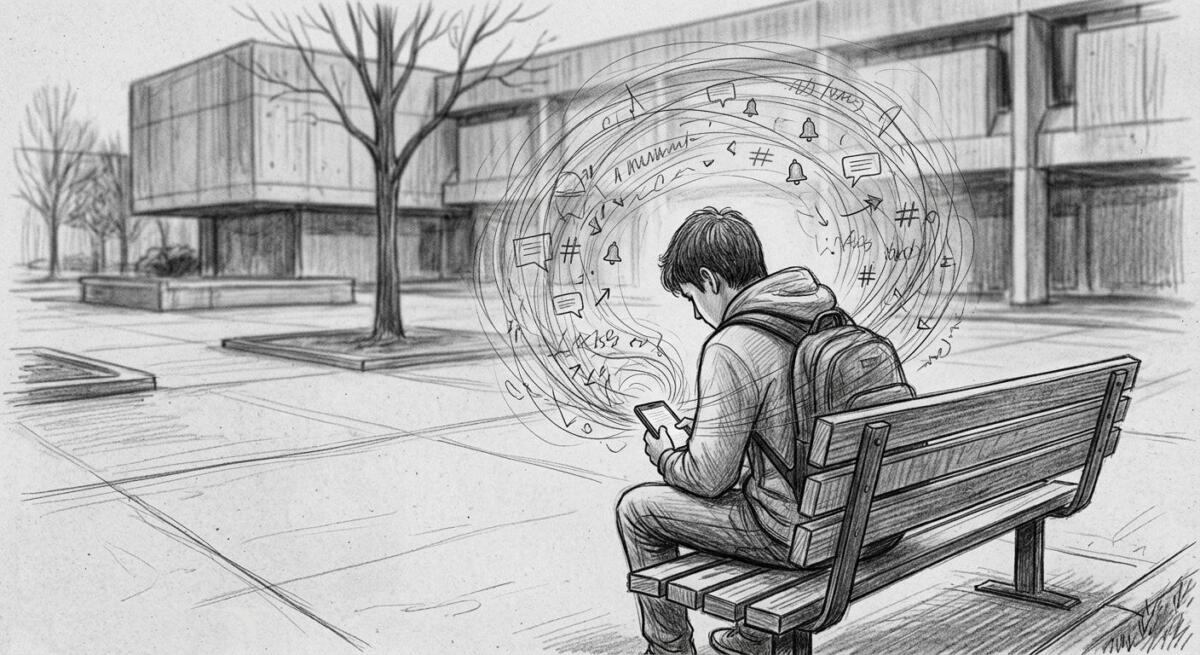
Here comes another study.
PsyPost published a fascinating and somewhat unsettling piece titled How smartphone use and feelings of disconnection fuel a vicious cycle, reporting on a new study from the journal Addictive Behaviors. The study tracked 104 first-year university students over 30 consecutive days and found clear evidence of a self-reinforcing loop: the more students used their smartphones problematically, the more disconnected and disengaged they felt the next day, and the more disconnected they felt, the more they reached for their phones.
The Loop Nobody Warned You About
Here is the part that should make you stop and think. This study did not just find a correlation between phone use and feeling bad. It found a daily, back-and-forth cycle that compounds over time. Day by day. Like a snowball rolling downhill.
The mechanics are actually pretty simple when you lay them out:
- A student feels bored or mentally checked out
- They reach for their phone to escape that feeling
- The phone delivers a quick hit of stimulation, videos, notifications, likes
- The next morning, they wake up feeling even more disconnected from real life
- So they reach for the phone again
This is not a coincidence or a quirk. This is, by clinical definition, a behavioral trap. And the study confirmed it using something called dynamic structural equation modeling, which is a method that separates each individual’s day-to-day changes from their overall personality patterns. In plain terms, the researchers made sure they were measuring genuine daily shifts in behavior, not just the habits of people who were already predisposed to heavy phone use. The cycle showed up regardless.
This Is Not About Willpower
One of the most important things the study’s author, Professor Jeong Jin Yu, said was this: “To break this cycle, you can’t just rely on willpower.”
That line matters more than people realize.
We live in a cultural moment where the dominant response to phone addiction is personal responsibility. Put the phone down. Use screen time limits. Be more disciplined. And while those things are not useless, they completely ignore the structural reality of what these platforms are designed to do.
Social media apps, short-form video platforms, notification systems, these are not neutral tools. They are engineered by teams of behavioral scientists and product designers whose entire job is to make you feel just uncomfortable enough when you are not using the app, and just rewarded enough when you are. The dopamine loop is not a bug. It is a feature. It is the product.
So when a burned-out 18-year-old reaches for their phone because they feel mentally detached and under-stimulated, they are not failing some test of character. They are responding exactly the way the platform was designed to make them respond. The cycle this study documents is not a personal weakness. It is a design outcome.
Young People Are Paying the Highest Price
The study focused on first-year university students, and that choice was deliberate. This is one of the most vulnerable periods in a young person’s life. They have just left home, they are navigating new social environments, facing real academic pressure, and for the first time in their lives, nobody is managing their screen time for them.
That combination is a perfect storm, and the platforms know it. Young adults are among the most profitable user demographics precisely because they are still forming habits. The behavioral patterns that take hold at 18 often stick around at 28 and 38.
What the study found is not just concerning for individual students. It points to a broader pattern that should alarm anyone paying attention:
- Students who felt more disengaged overall also reported higher overall smartphone use, not just on bad days
- The cycle was consistent across genders and socioeconomic backgrounds, meaning this is not a problem that affects only certain types of students
- Nobody appears to be immune based on family background or finances
This is a population-level problem being addressed, when it is addressed at all, with individual-level solutions
The Engagement Economy Does Not Want You to Disengage
Here is where the money comes in, because it always comes down to money.
Every minute a user spends scrolling is revenue. Every notification that pulls someone back to an app is a data point. Every algorithmically served piece of content that keeps someone on-platform for another thirty seconds is profit. The entire business model of modern social media and short-form content platforms is built on maximizing the time you spend inside them.
That model is fundamentally incompatible with your mental health.
The researchers found that genuine disengagement, that feeling of being checked out and bored, acts as a trigger that drives people toward their phones. Platforms have known about this dynamic for years. Internal research at companies like Meta has repeatedly shown that their products contribute to anxiety, comparison, and a kind of hollow restlessness that makes users more dependent, not less. They have chosen, consistently, to optimize for engagement rather than wellbeing.
The study recommends replacing scrolling with meaningful offline activities, joining clubs, volunteering, setting phone-free study hours. That advice is genuinely sound. But it places the entire burden of change on the individual while the platforms continue doing exactly what they were built to do: keep you coming back, feeling slightly worse each time.
What Happens If We Just Keep Scrolling
This is not a story about a small group of stressed college students in China. The behavioral loop documented in this study is the same loop playing out on every continent, in every age group, in every demographic. The study just happened to measure it cleanly enough to prove it scientifically.
If current trends continue without serious pushback, including regulatory pressure on platform design, genuine investment in digital literacy education, and cultural honesty about what these products actually do, we are looking at generations of people who are increasingly unable to sit with boredom, engage in deep focus, or find meaning in the physical world around them. That is not a dramatic prediction. It is a slow-moving reality that researchers are already measuring.
What you can actually do right now is pretty straightforward. Be honest with yourself about how you feel after using your phone compared to before. Notice the loop. Replace a scroll session with something that requires your full attention, a walk, a conversation, cooking, reading something long. Set hard limits on notification access. And most importantly, stop treating your inability to put the phone down as a personal failure, because the people who built these platforms spent billions of dollars making sure you would struggle to do exactly that.
The fight for your attention is real. The least you can do is know you are in one.
Read the original article here if you want to learn more: How smartphone use and feelings of disconnection fuel a vicious cycle
Subscribe to our newsletter to get updates delivered to your inbox