
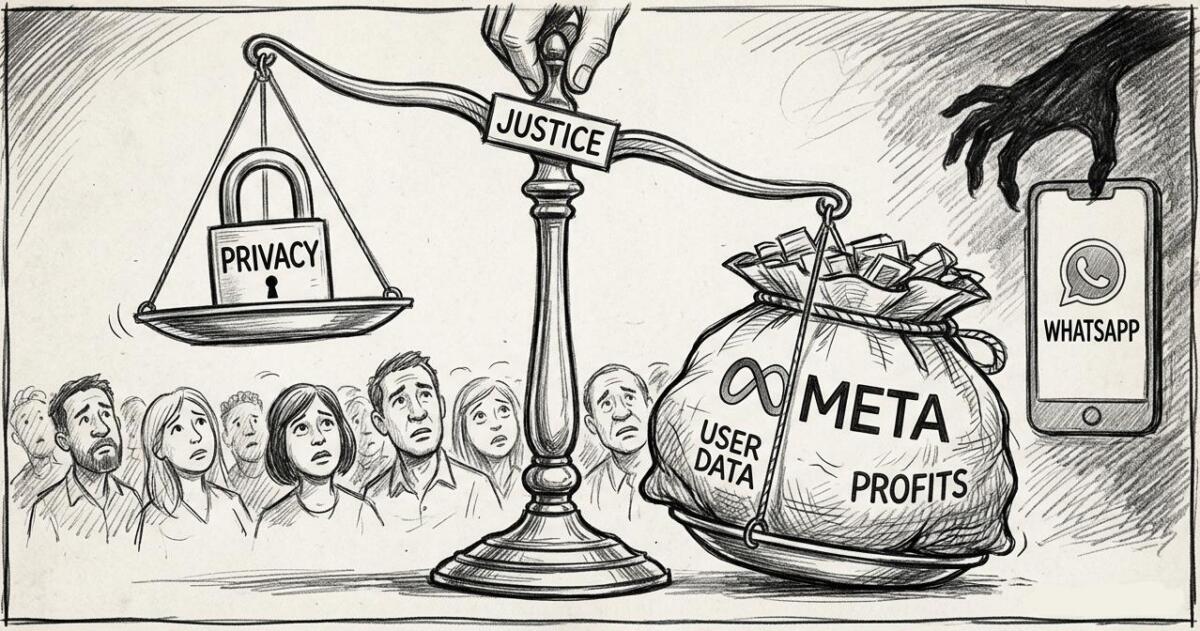
An article published by BBC News examines a landmark legal battle in India over WhatsApp’s 2021 privacy policy, which forces users to share their data with Meta for advertising or stop using the app entirely. India’s Supreme Court has ordered WhatsApp to give users control over how their data is shared and criticized the company for attempting to “play with” Indians’ right to privacy.
The “Take It or Leave It” Trap
WhatsApp has 853 million users in India. That’s not just a user base, that’s leverage. And in 2021, WhatsApp used that leverage to issue a simple ultimatum: agree to share your data with Meta for advertising, or delete the app and lose access to how you communicate with friends, family, and work contacts.
India’s competition watchdog called this what it is: a policy that leaves users with “no real choice.” When a platform becomes the primary way hundreds of millions of people stay connected, saying “just use something else” isn’t a realistic option. Alternatives like Signal and Telegram exist, but they don’t have your contacts, your groups, or your history. Switching isn’t easy when everyone you know is on WhatsApp.
This is how modern tech platforms operate. They build something genuinely useful, get everyone hooked, and then quietly change the rules once you’re too embedded to leave. The platform becomes essential infrastructure, and then it starts extracting value from you in ways you never agreed to when you signed up. Aka, Enshittification.
What’s Really Being Shared
WhatsApp insists that your messages are protected by end-to-end encryption, and that’s technically true. But the 2021 policy isn’t about reading your chats, it’s about collecting metadata: who you talk to, when, how often, what groups you’re in, what businesses you contact, your device information, your location data.
That metadata is incredibly valuable. It builds a detailed profile of your behavior, relationships, and interests, all of which can be used to target you with ads across Meta’s other platforms like Facebook and Instagram. You might think your private conversations are safe, but the data around those conversations is being harvested and monetized.
Here’s the problem, most people don’t understand what they’re agreeing to. They see a pop-up, feel pressured to click “accept” so they don’t lose access to the app, and move on. Informed consent requires understanding, and these policies are deliberately designed to be confusing, long-winded, and buried in legal language that discourages people from actually reading them.
Who Benefits, Who Pays
Meta benefits. They get access to behavioral data from nearly a billion people in one of the world’s largest internet markets. That data fuels their advertising machine, which generated over $130 billion in revenue in 2023 alone.
Users pay. Not with money, with privacy, autonomy, and control over their personal information. They’re told the service is “free,” but the real cost is invisible: your data, your attention, your behavior being analyzed and sold to advertisers without your meaningful consent.
Some argue this is just how the internet works, advertising funds free services, and users can always leave if they don’t like it. But that argument ignores power dynamics. When a platform becomes essential to daily life, “just leave” isn’t a real option. And when companies use their dominance to force policy changes on captive users, that’s not a fair exchange, it’s exploitation.
India’s Supreme Court seems to understand this. The judges didn’t just criticize WhatsApp’s policy, they called it “theft of private information” and warned Meta not to “make a mockery” of constitutional privacy rights. That’s unusually strong language from a court, and it reflects growing frustration worldwide with how tech companies treat user data as a resource to extract rather than something people have a right to control.
A Bigger Pattern
This isn’t just about WhatsApp in India. It’s about a business model that has become standard across the tech industry: build something useful, get users dependent, then monetize their data and behavior in ways they never explicitly agreed to.
What users see: A free messaging app that helps them stay connected.
What companies see: A data collection engine that turns human relationships into advertising revenue.
The fact that India’s government is pushing back is significant. For years, tech companies have operated with minimal oversight in developing markets, treating them as growth opportunities without much accountability. But India, with its massive population and growing digital economy, is now demanding that companies respect user rights and local laws.
The question is whether other countries will follow, or whether this remains an isolated case while the rest of the world continues accepting “take it or leave it” policies as normal.
The Illusion Of Choice
Even if you don’t live in India, this case matters because it challenges a core assumption of modern tech: that platforms can change the rules whenever they want, and users just have to deal with it.
Right now, the power balance is heavily tilted toward companies. They control the platforms, the policies, and the defaults. You’re given the illusion of choice, accept or leave, but that’s not real autonomy when the platform has become essential to your daily life.
What you can do:
- Actually read privacy policies when apps change them, especially for services you use daily.
- Question whether you really need every app and service you’ve signed up for, or if you’re just staying out of habit.
- Support regulations that give users real control over their data, not just the appearance of control.
- Recognize that “free” services aren’t free. You’re paying with your data, attention, and privacy. Decide if that trade-off is worth it.
The future of digital life doesn’t have to look like this. Technology can genuinely help people connect and communicate without turning every interaction into a data point for advertisers. But that only happens if people push back against the idea that exploitation is just “how things work” and demand something better.
Read the original article here if you want to learn more: WhatsApp: Why is the messenger’s privacy policy in India facing a legal challenge?
Subscribe to our newsletter to get updates delivered to your inbox