
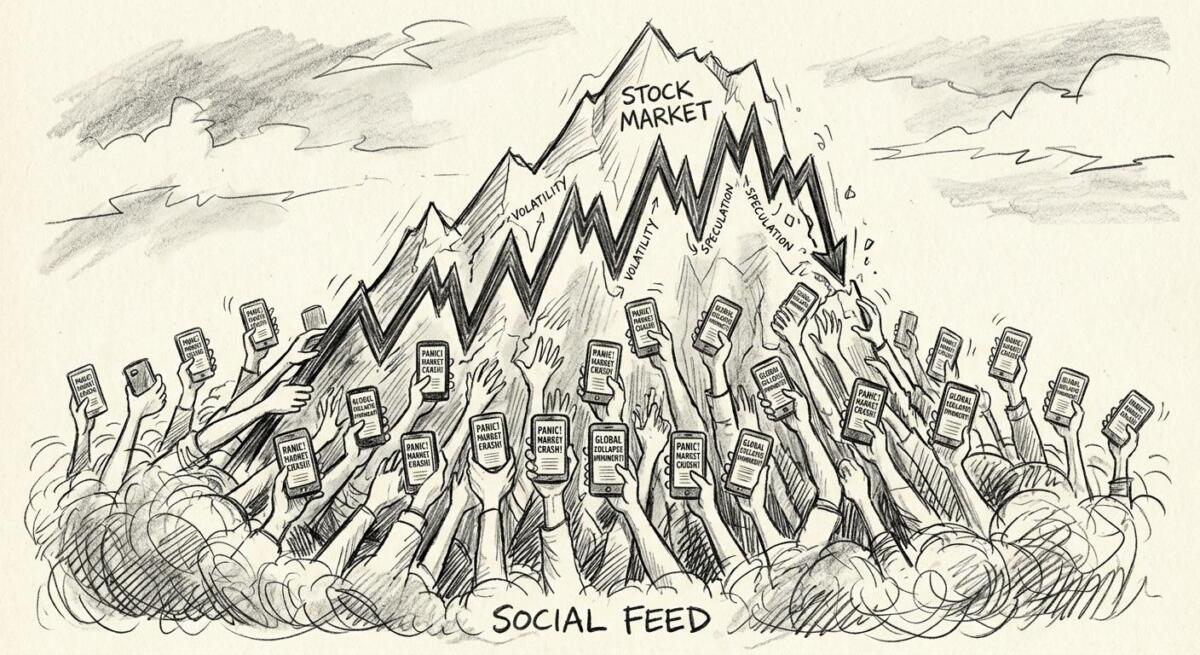
An article published in Fortune explores how viral misinformation spreading through smartphones is creating dangerous volatility in financial markets, potentially threatening economic stability.
When Your Doom Scroll Becomes Everyone’s Economic Crisis
Here’s what’s actually happening: A single blog post went viral over a weekend. It outlined a hypothetical scenario where AI destroys white-collar jobs, unemployment hits 10%, and the stock market crashes 38%. People read it on their phones. Markets moved 6%. Not because anything changed in the real economy. But because enough people, scrolling through social media, believed it might.
This is the new economic reality. Markets aren’t just reacting to fundamentals anymore. They’re reacting to whatever narrative is getting the most engagement on your phone screen. And the platforms serving you that content? They’re optimized for panic, outrage, and hype because that’s what keeps you scrolling.
The article reveals something genuinely alarming: We’ve created a system where smartphone algorithms, designed to maximize engagement, can now move trillions of dollars. Where a speculative essay can become “fact” simply by bouncing across enough screens. Where the line between economic analysis and viral fearmongering has completely dissolved.
The Perfect Storm Nobody Designed (But Everyone Profits From)
Three forces are colliding here, and none of them give a damn about market stability:
- Algorithmic amplification: Social media platforms are engineered to reward content that triggers emotional responses. Fear and outrage drive engagement. Engagement drives ad revenue. A calm, measured economic analysis doesn’t stand a chance against a viral doomsday scenario. The platforms know this. They’ve known it for years. But changing it would mean less money, so here we are.
- Retail investor power: Individual investors now account for $5.4 trillion in trading activity. They’re making financial decisions on their phones, often based entirely on what they see in their social feeds. High schoolers are trading options on Robinhood based on daily tech news. As one strategist put it: “If you put enough ants together, they can move a very big log.” These aren’t stupid people. They’re people getting information through channels specifically designed to manipulate their behavior.
- Deep uncertainty about AI: Nobody really knows what AI will do to the economy. That uncertainty creates fertile ground for speculation, fear, and wild narratives. When people are already anxious, algorithms amplify that anxiety, and suddenly a hypothetical scenario becomes a self-fulfilling prophecy.
The Incentive Problem
Here’s what makes this particularly dangerous: The platforms have zero incentive to fix this. Viral panic drives engagement. Engagement drives revenue. Whether that panic causes real economic harm is simply not their problem.
UBS economist Paul Donovan nailed it: People aren’t judging the economy based on actual data anymore. They’re judging it “through the sensationalized media output of their smartphone.” Your perception of economic reality is being shaped by algorithms that optimize for clicks, not truth.
And it’s working. Markets are now “jittery” and “increasingly disconnected from the economy.” Goldman Sachs warns that a sharp stock market correction triggered by viral panic represents the most significant downside risk to GDP growth. Translation: We might actually scroll ourselves into a recession.
When Fiction Becomes Fact (Because It Got Enough Likes)
The Citrini post that sparked this volatility was explicitly framed as a hypothetical scenario. Not a prediction. Not analysis. A “what if” thought experiment. But by the time it bounced across millions of smartphone screens, that nuance was gone. It became “news.” It became something people made financial decisions around.
This is the information ecosystem we’ve built. One where context dies in the feed. Where hypotheticals become headlines. Where fear travels faster than facts because fear is what the algorithms reward.
Real People, Real Consequences
This isn’t some abstract market theory. When markets crash because of viral panic, real people lose real money. Retirement accounts shrink. Jobs disappear. Economic anxiety spreads, which feeds right back into the panic cycle the algorithms are already amplifying.
The economists quoted in the article say the doomsday scenario itself is economically incoherent. It ignores basic macroeconomic principles. But that doesn’t matter. By the time experts debunk it, the damage is done. The panic has spread. The trades have been made.
We’re living in a world where the economic stability of nations can be threatened by whatever manages to go viral on a Sunday afternoon. Where teenage traders with smartphones wield collective power that can move markets. Where platforms optimized for engagement are accidentally (or not so accidentally) creating systemic economic risk.
What This Means For You
If you’re wondering why the economy feels increasingly unhinged from reality, this is why. The information reaching you about markets, jobs, and economic trends is filtered through systems designed to maximize your emotional response, not your understanding.
What’s at risk isn’t just market stability. It’s our collective ability to distinguish between legitimate economic concerns and algorithmically amplified panic. Between thoughtful analysis and viral fearmongering. Between what’s actually happening and what’s trending.
You can’t fix the platforms. But you can recognize what they’re doing to you. When you see economic doomsday scenarios going viral, ask: Who benefits from this panic? What actual evidence supports it? Am I reacting to information or to how that information was designed to make me feel?
Because right now, the systems feeding you information about the economy are the same systems that turned social media into an addiction machine, mental health crisis, and misinformation superhighway. They haven’t suddenly developed a conscience about economic stability.
The market might be looking for an excuse to fall, as the article suggests. But we don’t have to hand it one, perfectly packaged for virality, every time we pick up our phones.
Read the original article here if you want to learn more: People are getting fake news on their phones and that’s increasing the risk of a market crash
Subscribe to our newsletter to get updates delivered to your inbox