
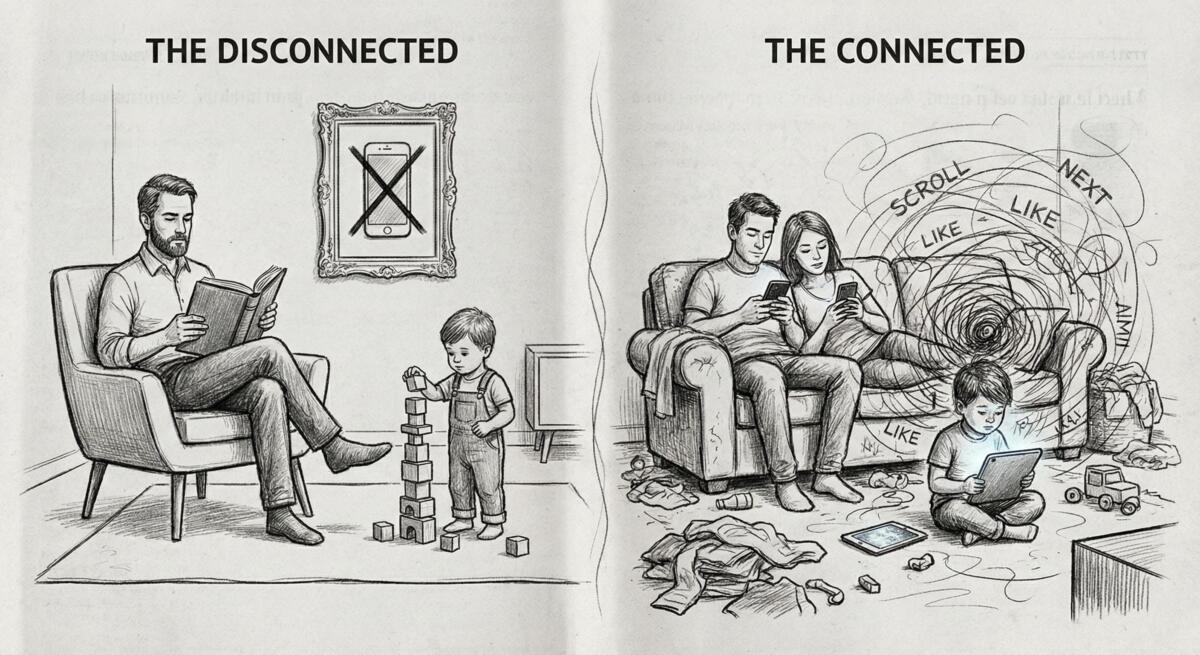
Fortune recently published an article titled “Tech billionaires are publicly shielding their children from the products that made them rich” that highlights how Silicon Valley’s most powerful figures, including Peter Thiel, Bill Gates, and Steve Jobs, strictly limit their own children’s access to the very technologies they created and profited from. The article notes that children in the U.S. ages 8 to 18 now spend an average of 7.5 hours per day on screens, while tech leaders like Thiel allow their kids just 90 minutes per week.
They Know What They Built
The behavior speaks louder than any PR statement ever could. When Steve Jobs told The New York Times in 2010 that his kids had never used an iPad, it wasn’t a quirky parenting choice. It was a confession. When Peter Thiel limits his children to 90 minutes of screen time per week while the average American kid is glued to a device for over seven hours a day, that’s not just caution. That’s someone who knows exactly what he’s selling and refuses to let it anywhere near his own family.
These aren’t technophobes. These are the architects. They built the engagement loops, approved the infinite scroll, and designed the algorithms that keep people, especially young people, hooked. And then they went home and banned it all from their own dinner tables.
The Admission Hidden in Plain Sight
YouTube cofounder Steve Chen admitted that short-form content “equates to shorter attention spans” and said he wouldn’t want his kids consuming it. TikTok’s CEO acknowledged his own children were too young for the platform he runs. Bill Gates didn’t let his kids have smartphones until they were 14. Evan Spiegel, who runs Snapchat, mirrors Thiel’s 90-minute weekly limit.
This isn’t about being careful. This is about knowing the product is harmful and choosing profit anyway. A drug dealer doesn’t use their own supply because they know what it does. Tech billionaires don’t let their kids use social media for the exact same reason. They’ve seen the research. They’ve watched the engagement metrics. Not only that, but they know that these platforms are designed to exploit attention, trigger dopamine loops, and keep users scrolling long past the point of benefit.
And the science backs them up. A 2025 study of nearly 100,000 people found that short-form video use was directly linked to worse cognition and declining mental health across all age groups. Countries like Australia have started banning social media for kids under 16. Lawsuits are piling up. The evidence is everywhere.
But the platforms keep running. The algorithms keep optimizing. And the people who built them keep their own families far, far away.
The Products vs. The People Who Made Them
Here’s the thing that really stings: these tools could have been designed differently. Technology can connect people, spread knowledge, and genuinely improve lives. Social media could foster real community. Video platforms could educate and inspire. AI could solve actual problems instead of flooding the internet with slop.
But that’s not what we got. What we got was a business model built on addiction. Platforms designed to maximize time on site, not human well-being. Algorithms that amplify outrage because anger drives engagement. Features like infinite scroll and autoplay that override self-control. Entire ecosystems engineered to extract attention and sell it to advertisers.
The people who designed these systems understood exactly what they were doing. They A/B tested every feature to find what kept users hooked longest. They hired neuroscientists and behavioral psychologists to fine-tune the dopamine hits. They watched kids develop anxiety, depression, and fractured attention spans, and kept optimizing for growth.
And when it came time to raise their own children? They said no. Firmly. Publicly. Because they know.
The Hypocrisy Exposed
If the people who built these platforms won’t let their own children use them, why are the rest of us handing our kids iPads at age three? Why are we accepting that seven-and-a-half hours of screen time per day is just “how things are now”?
This isn’t inevitable. This is a choice being made for us by people who’ve quietly opted out for themselves. They’re building doomsday bunkers while telling everyone else the future is fine. They’re limiting their kids to 90 minutes a week while running platforms designed to keep yours hooked for 50 hours.
The risk isn’t abstract. We’re watching an entire generation grow up with shorter attention spans, higher anxiety, worse cognition, and a worldview shaped by algorithms designed to maximize engagement, not truth. We’re watching social trust collapse as people retreat into algorithmic echo chambers. We’re seeing mental health crises spike, especially among young people who’ve never known a world without these platforms.
And the people responsible? They saw it coming. They’re protecting their own families while profiting off everyone else’s.
Here’s what you can do: Set your own limits. Create screen-free zones and times in your home. Teach your kids that these platforms are designed to manipulate them. Don’t accept “everyone else is doing it” as a reason to hand over control. And most importantly, stop trusting the people selling you these tools to tell you the truth about what they do. They already showed you what they really think. They just did it quietly, at home, away from the cameras.
Read the original article here if you want to learn more: Tech billionaires are publicly shielding their children from the products that made them rich
Subscribe to our newsletter to get updates delivered to your inbox