
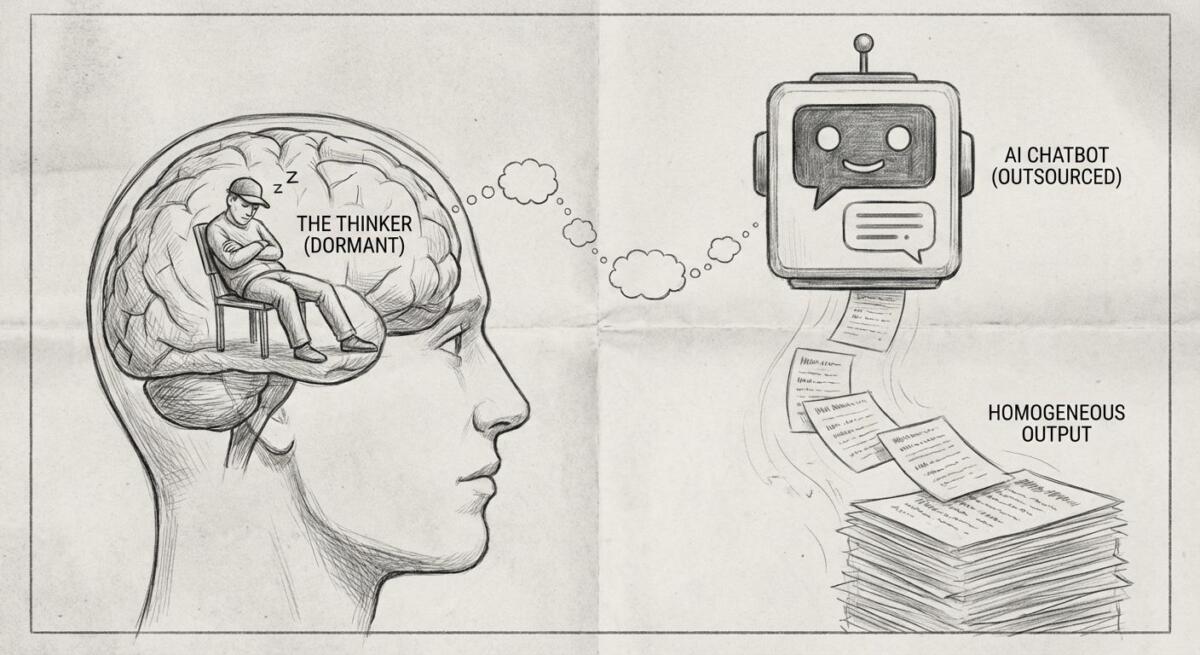
A research paper published by MIT titled “Your Brain on ChatGPT: Accumulation of Cognitive Debt when Using an AI Assistant for Essay Writing Task” examined what happens to our brains when we use AI tools like ChatGPT for writing. Researchers at Boston-area universities tracked 54 participants across multiple essay-writing sessions, measuring brain activity, memory retention, and sense of ownership over their work.
We’re Literally Thinking Less When AI Does the Heavy Lifting
The study used EEG brain scans to measure neural connectivity while people wrote essays. The results were stark. People writing without any tools showed the strongest, most widespread brain activity, especially in regions tied to working memory, creative thinking, and deep processing. People using search engines showed moderate activity. And people using ChatGPT? Their brains were barely firing.
This isn’t just about “using a tool.” It’s about what happens when the tool does the thinking for you. When you use a search engine, you still have to read, evaluate, synthesize, and create your own argument. When you use ChatGPT, it generates the argument for you. Your brain steps back. The neural pathways that should be firing during creative work go quiet.
And when people who had been using ChatGPT were asked to write without it in a later session, their brains still showed weaker connectivity than people who had been writing on their own all along. It’s like their brains had learned to expect the AI to do the work. That’s what the researchers call “cognitive debt”, you save effort now, but you pay for it later when your thinking muscles have atrophied.
Your Memory Suffers, and You Don’t Even Own Your Work
The memory results were troubling. People who used ChatGPT couldn’t accurately quote their own essays just minutes after writing them. Think about that. They had just written something, or rather, ChatGPT had generated it while they watched, and they couldn’t remember what it said.
People writing on their own could quote themselves. They owned their ideas because they had actually generated them. The ChatGPT users felt the least ownership over their essays and described them as partially created by the AI. Because they were.
This matters beyond school assignments. If you can’t remember what you’ve written, you haven’t actually learned anything. You’ve just moved words around. The process of writing is supposed to solidify your thinking, force you to organize ideas, and help you remember what you’ve learned. When AI does that work, none of that happens. You’re left with a finished product and an empty head.
The Essays All Start to Sound the Same
The linguistic analysis showed that essays written with ChatGPT were more homogeneous, they used similar references, similar structures, similar language. Essays written by people thinking on their own were more diverse, more personal, more human.
Human teachers noticed this too. They described AI-assisted essays as “soulless.” The AI judge the researchers built gave high, consistent scores to the ChatGPT essays. But human teachers valued uniqueness, personal insight, and original thinking, things the AI-written essays lacked.
This is the long-term cultural cost. If everyone starts writing with AI, we all start sounding the same. Original thinking gets replaced by statistically average outputs. Creativity becomes conformity. And because the AI was trained on existing content, it can only remix what already exists. It can’t generate truly new ideas. Only humans can do that, but only if we actually use our brains.
So, What Do We Do?
This study matters because it shows what happens when we let AI do our thinking for us. We become less capable thinkers. We remember less. We feel less ownership over our work. And our brains literally change, they stop engaging the neural networks that make us creative, critical, and independent.
If current trends continue, we risk raising a generation that can’t write, can’t think critically, and can’t remember what they’ve learned because they’ve outsourced those functions to machines. The promise of AI is that it will augment human intelligence. The reality, if we’re not careful, is that it will replace it.
You don’t have to reject AI entirely. But you do need to be aware of the trade-offs. Use it for brainstorming or editing if you want, but do your own thinking. Write your own first drafts. Let your brain do the hard work of organizing ideas, choosing words, and building arguments. That struggle is not a bug. It’s the entire point. It’s how you learn, how you grow, and how you stay sharp.
The tech companies won’t tell you this. They benefit when you rely on their tools. But your brain doesn’t care about their business model. It only responds to how you use it. And right now, we’re training it to do less.
Read the study here if you want to learn more: Your Brain on ChatGPT: Accumulation of Cognitive Debt when Using an AI Assistant for Essay Writing Task
Subscribe to our newsletter to get updates delivered to your inbox