
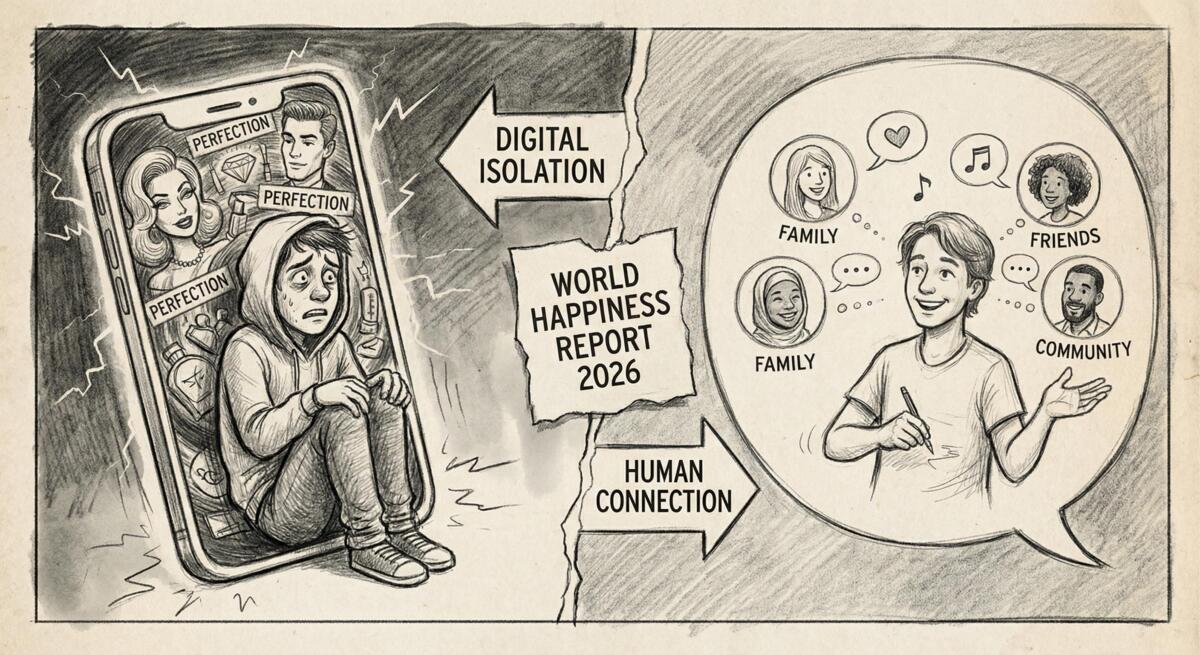
An article published in The Guardian examines findings from the 2026 World Happiness Report, which analyzed how different types of social media platforms affect mental health across 17 countries. The research found that algorithm-driven apps like Instagram and TikTok are significantly more harmful to users’ wellbeing than connection-focused platforms like WhatsApp and Facebook.
Not All Feeds Are Created Equal
Here’s something you probably already knew from experience but couldn’t quite prove: endlessly scrolling through Instagram at 2am makes you feel like garbage, while texting your friends on WhatsApp generally doesn’t.
The World Happiness Report finally put numbers to that feeling. Researchers found that platforms designed around algorithms and influencer content—Instagram, TikTok, and X—consistently led to lower happiness and increased mental health problems. Meanwhile, apps focused on actual human connection, like WhatsApp and Facebook, were associated with higher life satisfaction.
Why? Because one type of platform is built to connect you with people you actually know, while the other is designed to keep you scrolling through an infinite stream of curated perfection from strangers. Guess which business model makes more money? (Hint: it’s not the one that’s good for you.)
The Goldilocks Zone Nobody’s Actually In
The research uncovered something genuinely interesting that people who use social media for about an hour a day reported higher life satisfaction than people who don’t use it at all. There’s apparently a sweet spot where technology genuinely helps you stay connected without hijacking your brain.
The problem? Almost nobody is actually in that zone. The average user spends around two-and-a-half hours per day on social media. That’s not accidental because these platforms employ some of the smartest psychologists and engineers on the planet to make sure you can’t stick to just one hour. Features like infinite scroll and autoplay aren’t bugs, they’re the entire business model.
So we have research showing that moderate use is beneficial, but platforms specifically designed to make moderation impossible. It’s like a casino publishing a study showing that responsible gambling is fun, while removing all the clocks and pumping pure oxygen through the vents!!
The Scale of Harm Is No Longer Debatable
Here’s where this gets serious. The 2026 World Happiness Report’s Chapter 3 examined seven independent lines of evidence about social media’s impact on adolescents:
- Direct surveys of young people
- Reports from parents, teachers, and clinicians
- Internal corporate documents (yes, the companies know)
- Cross-sectional studies
- Longitudinal studies tracking kids over time
- Experiments where teens reduced social media use
- Natural experiments when circumstances forced usage changes
All seven lines pointed to the same conclusion: social media platforms are causing “severe and widespread” harm to adolescents, particularly girls. We’re talking about depression, anxiety, cyberbullying, and sextortion at a scale large enough to show up in population-level data.
The researchers argue that the evidence is now “overwhelming” and “compelling.” Yet social media executives continue playing a clever game as they deflect questions about product safety by demanding impossible levels of proof about historical trends. It’s the tobacco playbook all over again, create confusion, demand certainty where uncertainty is inherent, and keep selling the product while the debate drags on.
Algorithm vs. Connection
The people hurt most by this deliberate confusion are the ones who can’t wait for academic debates to resolve: teenagers living through their formative years right now, parents trying to make decisions without clear guidance, and entire societies watching youth mental health deteriorate in real time.
Countries like Australia have started raising the minimum age for social media accounts to 16, essentially treating these platforms like what they are: products that aren’t safe for children. The research supports this approach, but you can already hear the pushback: “We need more evidence.” “Correlation isn’t causation.” “What about digital literacy?”
These arguments might sound reasonable, except they ignore that we already ran the experiment. In the 2010s, we handed smartphones and social media accounts to an entire generation of children with basically zero safety testing. We now have over a decade of data showing the damage. The “experiment” the researchers mention isn’t hypothetical, it already happened, and the results are in.
The question isn’t whether we have enough evidence. The question is whether we’re willing to act on evidence that threatens a business model worth hundreds of billions of dollars. Spoiler: the platforms are hoping the answer is no, and they’re spending a fortune to make sure it stays that way.
This is about recognizing that we handed enormous power to companies that prioritized engagement metrics over human wellbeing, and those companies used that power exactly as you’d expect profit-driven entities to use it.
If current trends continue, we’re looking at generations of young people whose baseline mental health is measurably worse than their parents’, whose ability to focus has been systematically degraded, and whose understanding of social connection has been shaped by algorithms designed to maximize ad revenue.
What can you actually do about this? Start by recognizing that “moderate use” requires fighting against systems specifically built to prevent it. Set real boundaries. Delete apps that make you feel worse. Talk to young people in your life about what they’re experiencing.
And most importantly, stop waiting for permission from the platforms to protect yourself and the people you care about. They’ve shown us who they are. Believe them.
Read the original article here if you want to learn more: Instagram worse for mental health than WhatsApp, global study finds
Read the World Happiness Report 2026
Subscribe to our newsletter to get updates delivered to your inbox