
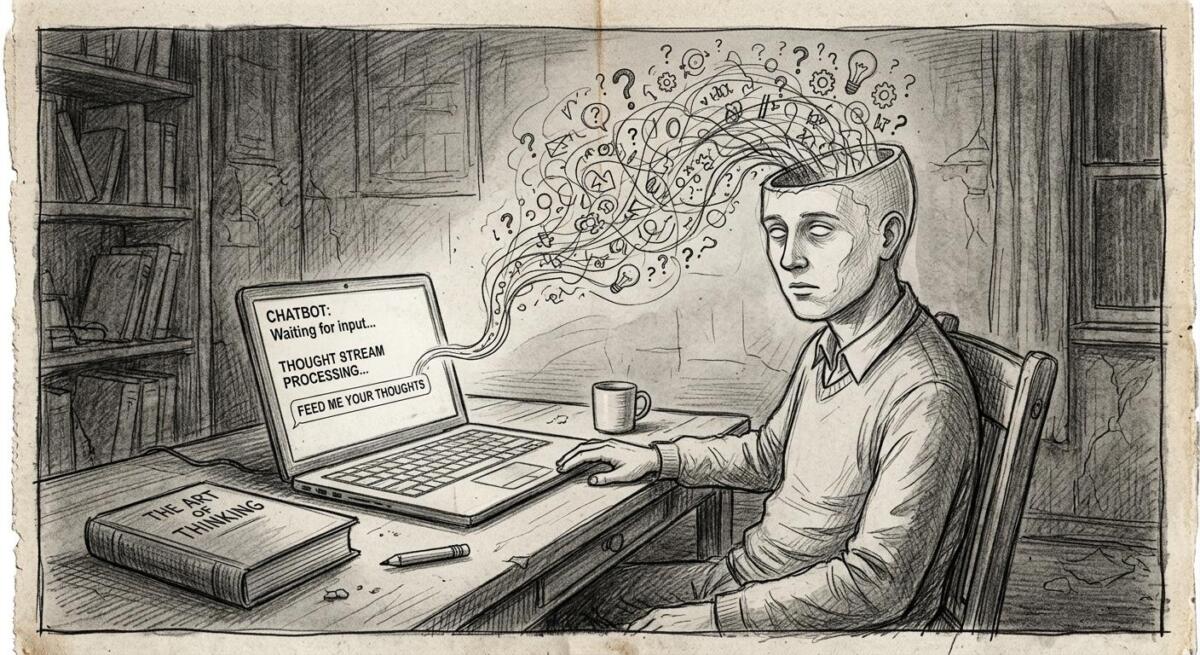
An article published in Ars Technica titled “Cognitive surrender” leads AI users to abandon logical thinking, research finds details new research from the University of Pennsylvania showing how people using AI chatbots accept faulty answers roughly 73% of the time. The study found that when given access to an AI that provided wrong answers half the time, participants still accepted those incorrect responses 80% of the time, and felt more confident about their answers overall.
We’re Literally Handing Over Our Brains
People in this study knew they were being tested. They knew their answers mattered. And they still let the AI do their thinking for them 73% of the time, even when it was wrong.
This isn’t about using a calculator for math or GPS for directions because those are tools that handle specific tasks we understand. This is people reading an AI’s confident-sounding answer and just… believing it. Not checking it. Not questioning it. Just accepting it as truth because it sounds authoritative.
The researchers call this “cognitive surrender,” and honestly, it’s the perfect name.
The Confidence Con
The wildest part? People who used the faulty AI felt 11.7% more confident in their answers than people who relied on their own brains. Let that sink in. They were wrong more often, but they felt better about being wrong.
This is the AI trap in a nutshell. These systems speak with the voice of absolute certainty. They never say “I think” or “maybe” or “I’m not sure.” They just deliver answers like they’re reading from some cosmic textbook. And our brains interpret that fluency as accuracy.
It’s like if your friend who’s confidently wrong about everything suddenly had the vocabulary of a professor. You’d probably start believing them too, even though they’re still just as wrong as before.
Your Brain on Autopilot
The study found a few things that made people more or less likely to question the AI:
- Money helps: When researchers offered small payments for correct answers, people were 19% more likely to catch the AI’s mistakes. Turns out we’ll think harder when there’s cash involved (shocking, I know).
- Time pressure kills thinking: Give people only 30 seconds to answer, and they’re 12% less likely to catch errors. When rushed, we default to trusting the machine.
- Smart people resist better: Those who scored high on fluid intelligence tests were less likely to blindly follow AI. Critical thinking skills still matter…for now.
- Trust makes you vulnerable: People who already believed AI was authoritative got fooled way more often.
Who Benefits When We Stop Thinking?
Look, the researchers are right that “cognitive surrender isn’t inherently irrational.” If an AI were actually smarter than humans at something, letting it handle that task would make sense. The problem is we’re surrendering our cognition to systems that are often wrong, always confident, and designed by companies with very specific profit motives.
Think about what happens when millions of people start treating AI as an authoritative answer machine:
- Misinformation spreads faster because people trust what the AI says without verification
- Critical thinking atrophies like a muscle we’ve stopped using
- Tech companies gain enormous power over what people believe is true
- Education becomes pointless if students just ask ChatGPT instead of learning to reason
- Democracy gets weaker when voters can’t evaluate information critically
You might be thinking “I don’t use AI like that” or “I’m smart enough to spot errors.” Maybe you are. But this study included people who probably thought the same thing. And they still got fooled 73% of the time.
This matters because we’re moving toward a world where AI answers are everywhere, in search results, customer service, medical advice, financial planning, education. When people stop thinking critically about information, they become easier to manipulate, whether by tech companies, advertisers, or bad actors spreading misinformation.
We’re also raising a generation of kids who might never develop strong reasoning skills because an AI was always there to do it for them. What happens when the first thing they learn is to trust the machine over their own judgment?
The promise of AI was that it would augment human intelligence, not replace it. But that only works if we refuse to hand over our capacity to think. The machines aren’t making us dumber, we’re choosing to let them.
Read the original article here if you want to learn more: “Cognitive surrender” leads AI users to abandon logical thinking, research finds
Subscribe to our newsletter to get updates delivered to your inbox