
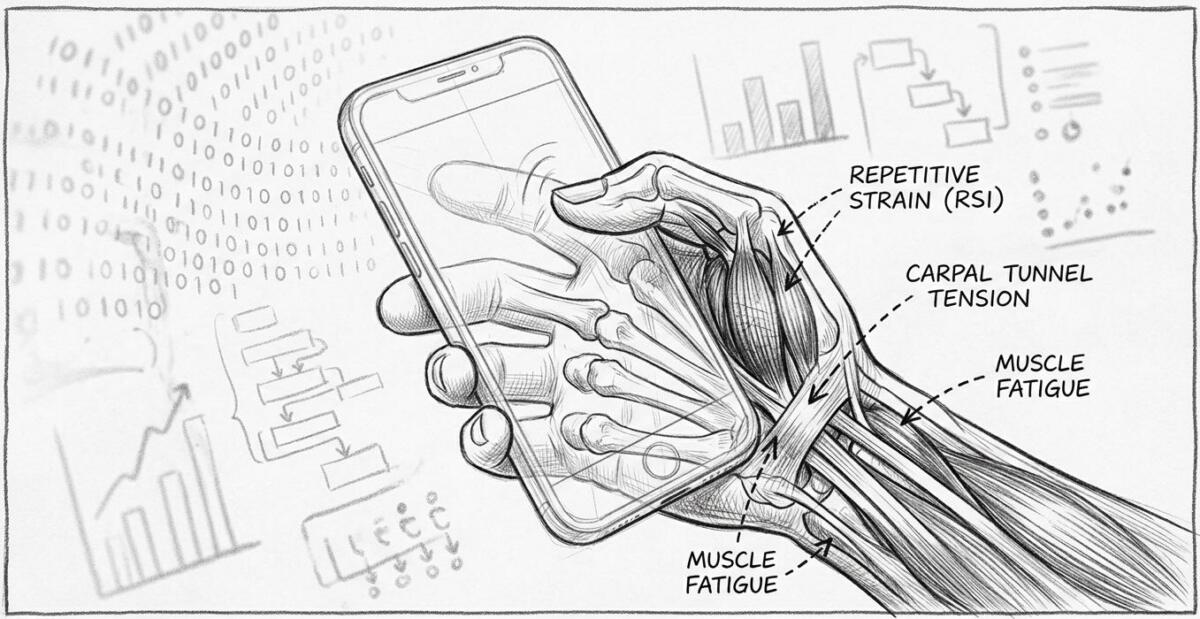
A new study published in the Proceedings of the 2026 CHI Conference on Human Factors in Computing Systems reveals how researchers have developed an AI system called Log2Motion that tracks the physical toll of smartphone use. The system analyzes every muscle movement required for taps, swipes, and scrolls, data that tech companies have conveniently ignored while harvesting everything else about our behavior.
Your Thumb Wasn’t Built for This
Tech companies know exactly when you tap a button, how long you looked at a post, and what made you click. They’ve built billion-dollar empires on that data. But they have zero interest in knowing whether reaching that button is slowly destroying your thumb joint.
Log2Motion changes that. It’s an AI system that simulates a digital human body with 63 muscle-tendon units. It watches how you interact with your phone and reverse-engineers every tiny muscle movement required to make it happen. The researchers even account for “motor noise”, those small human inconsistencies in how we move, because we’re not robots (yet).
The breakthrough is something called “screen mirror,” which lets this simulated body interact with real Android apps in real time. A virtual finger can now swipe through Instagram or catch Pokémon, and researchers can measure the actual physical effort required. When they tested it against real humans, the results matched up, meaning it’s tracking real physical strain.
The Body Keeps the Score
Think about your daily phone routine. You’re probably:
- Craning your neck at weird angles for hours
- Stretching your thumb to reach buttons designed by people who apparently have giant hands
- Holding your arm in unnatural positions while you doomscroll through bad news and worse takes
- Repeating these movements hundreds, maybe thousands of times a day
Your body wasn’t designed for this. Hell, your body wasn’t even designed to sit in chairs all day, and we already know how that’s going. Now add 4-6 hours of daily phone use with repetitive micro-movements that slowly build up strain in muscles and tendons.
The researchers are hoping app developers can use this data to identify problem spots before apps launch, like buttons that are too far away or gestures that require unnecessary effort. Which sounds great in theory. But let’s be real that these companies have known for years that infinite scroll is addictive, that autoplay keeps people watching, and that pull-to-refresh mimics slot machines. They chose engagement over everything else.
While Your Brain Was Rotting, Your Body Was Too
We’ve spent years studying how phones mess with our mental health, the anxiety, the depression, the attention span of a goldfish on Red Bull. All valid concerns. But we’ve completely ignored the fact that using these devices requires physical actions performed over and over, hour after hour, day after day.
Your muscles are telling you something. That ache in your thumb? That stiffness in your neck? That’s not “getting old”, that’s your body literally protesting the unnatural positions required to use technology designed without any consideration for human anatomy.
Your Thumb Is Tired
This research matters because it makes the harm tangible. We’re not just talking about abstract concepts like “brain rot” or “screen addiction” anymore. We’re talking about measurable physical damage to your actual body parts.
If current trends continue, and let’s be honest, it will, we’re looking at a generation dealing with repetitive strain injuries from their teenage years onward. Chronic neck problems. Thumb arthritis at 35. And the tech companies that designed these addictive interfaces? They’ll keep harvesting your data while you develop carpal tunnel.
Here’s what you can actually do:
- Set real time limits on your phone and stick to them (yes, it’s annoying, that’s the point)
- Notice when your body hurts and actually stop using your phone
- Hold your phone at eye level instead of hunching over it like Gollum with the Ring
- Question whether you really need to check Instagram again or if your thumb just needs a break
So, it’s on you to protect your body from technology that was never designed with your body in mind.
Read the original article here if you want to learn more: Scientists Figured Out What Endless Scrolling Is Really Doing to Your Body
Subscribe to our newsletter to get updates delivered to your inbox