
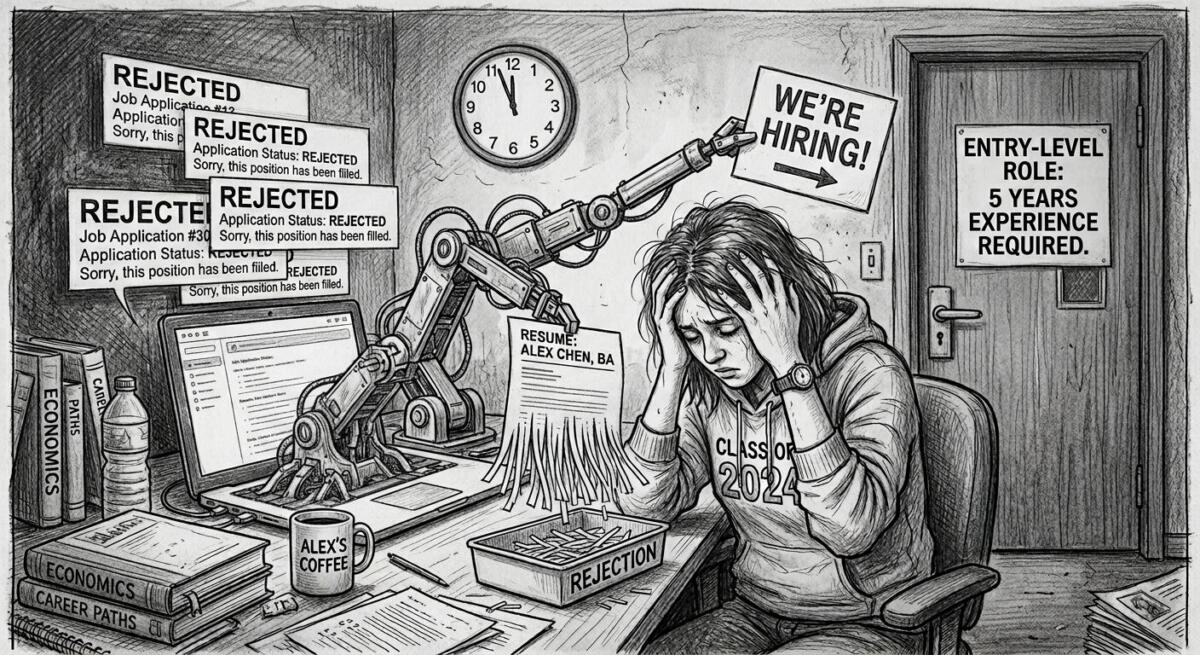
An article published in The Guardian reveals that American college graduates are facing their worst entry-level job market since the pandemic, with the underemployment rate hitting 42.5%. Several recent grads shared stories of spending hundreds of hours applying to jobs, only to be ghosted by algorithms before a human ever sees their resume.
Robots Read Your Resume (And Humans Don’t)
Companies have discovered they can use AI screening tools to filter through thousands of applications without paying an actual human to do it. Sounds efficient, right? Except these systems are rejecting qualified candidates based on arbitrary keyword matching while job seekers spend hours tailoring each resume to please a machine they’ll never understand.
One NYU graduate put it perfectly: “I hate that I have to worry about passing a machine’s arbitrary and unknowable tests before anyone considers my human capability.” They’re playing a guessing game with an algorithm that has zero accountability and even less empathy. And if you fail? You’ll never know why, because the bot won’t tell you.
The “Entry-Level” Job That Requires Five Years of Experience
Let’s talk about this bullshit for a second. Entry-level jobs now routinely ask for 3-5 years of experience. How exactly does that work? Did employers just forget what “entry-level” means, or are they using AI to filter out anyone who doesn’t perfectly match an impossible checklist?
Companies have figured out they can demand more while offering less, because there are 50 other desperate graduates willing to apply. Why train someone when you can hold out for a unicorn who’s somehow accumulated half a decade of experience before graduating?
Gillian Frost, a 22-year-old economics major, has applied to over 90 jobs since September. She’s been automatically rejected by 55% of them and ghosted by another 25%. She spends two hours every weekend just submitting applications, basically a part-time job that pays nothing and leads nowhere. And sadly, most of those rejections happened before a human ever looked at her qualifications.
AI Has Made Us Unemployable
AI was sold as a tool to enhance human productivity and free us from tedious work. But what actually happened? Companies are using it to eliminate entry-level positions entirely while making it harder for humans to get hired.
Jeff Kubat spent eight years in accounting, went back to school for a master’s degree, and still can’t land a job. Why? Because companies would rather use AI to automate basic accounting tasks than train someone with relevant experience. They’re “being incredibly literal in who they’re looking for” with “a dearth of willingness to train people.”
i.e., if you don’t fit the exact profile the algorithm is programmed to find, you’re out. No nuance, no potential, no consideration of what you could become with a little training. Just instant rejection by a machine that doesn’t care if you spent $100,000 on your degree or worked your ass off to get here.
The Hidden Cost of “Efficiency”
Anna Waldron, a journalism and political science double major who’s done three internships including one with the US Senate, can’t find work because “a lot of jobs don’t get posted on these sites because they hire internally or keep it ‘in the circle of the company.'”
So not only are you competing against AI screening tools, you’re also locked out of opportunities because companies prefer to hire through networks you can’t access. The playing field isn’t just uneven, it’s deliberately designed to keep you out unless you already have connections.
Meanwhile, companies are saving money by using AI to screen applicants, cutting training programs, and demanding more experience for less pay. They’re calling it “efficiency,” but what they really mean is: we found a way to squeeze more value out of fewer people while externalizing the human cost onto young workers who have no choice but to accept worse conditions.
Why This Should Scare the Hell Out of Everyone
This is now about an entire generation being told their education, skills, and potential don’t matter unless they can trick an algorithm into passing them through.
You can’t build a functional economy when the people who are supposed to be entering the workforce are stuck in an endless loop of rejections from machines. This isn’t sustainable, and it sure as hell isn’t fair.
Read the original article here if you want to learn more: ‘I feel helpless’: college graduates can’t find entry-level roles in shrinking market amid rise of AI
Subscribe to our newsletter to get updates delivered to your inbox